Which March Madness champion is the best college basketball team of all time?

Every March during the excitement of March Madness, the age-old question resurfaces: which college basketball team reigns supreme as the greatest of all time, and which championship team stands above the rest?
I’m sorry to the 1979 Indiana State Sycamores, 1983 Houston Cougars, and 1991 UNLV Rebels, but a team cannot be deemed the best of all time if it cannot advance through its own NCAA Tournament bracket. Victory in the postseason is essential to greatness, as March is where legends are made and legacies are built.
Which past champion would emerge victorious in a tournament to determine the ultimate college basketball champion? Which teams would be selected to participate in this historic event, and which players would make a lasting impact on this legendary competition?
To address all of these questions, we have thoroughly researched the history of tournaments to finally determine the “greatest team” before the 2026 NCAA Tournament. We have created a 64-team bracket that covers eight decades of basketball, complete with betting odds for each matchup in this prestigious Tournament of Champions. Get ready for an exciting ride.
How does the tournament work?
Picture this: all past NCAA Tournament champions are frozen in time.
Immediately after winning the championship, they were taken to a neutral court at a neutral time to find out their seed in a 64-team tournament to determine the ultimate champion.
With 84 title winners to select from, not every team will be included. The ones that are selected will endure a challenging journey unlike anything college basketball has experienced before.
Selection process
To ensure fairness, we enlisted a committee of robot overlords to assist in selecting the initial 64 teams for the tournament. The committee underwent extensive training to improve its decision-making process and utilized historical data to determine seedings based on three equally important factors.
- Resume: This committee was instructed to consider a team’s overall statistical resume, including its record, margin of victory, strength of schedule, and any other metrics that may help determine a team’s qualifications for this tournament.
- Eye test: This committee was instructed to consider the talent on a team’s roster, as judged by accolades won in college (All-American, All-Conference, Player of the Year), eventual NBA draft status and success, and even recruiting data where available. This also includes a team’s coaching talent and acumen.
- Subjective comparison: This committee was instructed to consider the public discourse surrounding these teams and use any available resources (articles, rankings, and other relevant lists) to help establish historical dominance by era and overall worthiness for inclusion in this tournament.
The committee received training on the logistics of sports betting, focusing on college basketball. This knowledge was utilized to establish the initial betting odds for the tournament, including the point spread, moneyline, and total for all 63 matchups.
Tournament rules
Although the competing teams come from various eras of college basketball, the tournament will adhere to current officiating rules. This means there will be some notable differences from the rules used in the early days of the sport.
- 3-point line (22 feet, 1.75 in)
- 30-second shot clock
- Dunking is allowed
While it may appear that current champions would have the most to gain from modern rules, it’s important to recognize that there were many skilled shooters before the introduction of the 3-point line in the 1980s. Additionally, some of the greatest teams in history were held back for years by rules such as the ban on dunking and opponents stalling without a shot clock.
Similar to March Madness, each team will have a five to six day break before facing their first opponent, followed by two days of preparation for the next game. This cycle continues until one team emerges victorious. The outcomes of these matchups will be influenced by key factors such as coaching, star players, adaptability, and a touch of luck, just like in any college basketball tournament.
Tournament of Champions bracket, seeding reactions
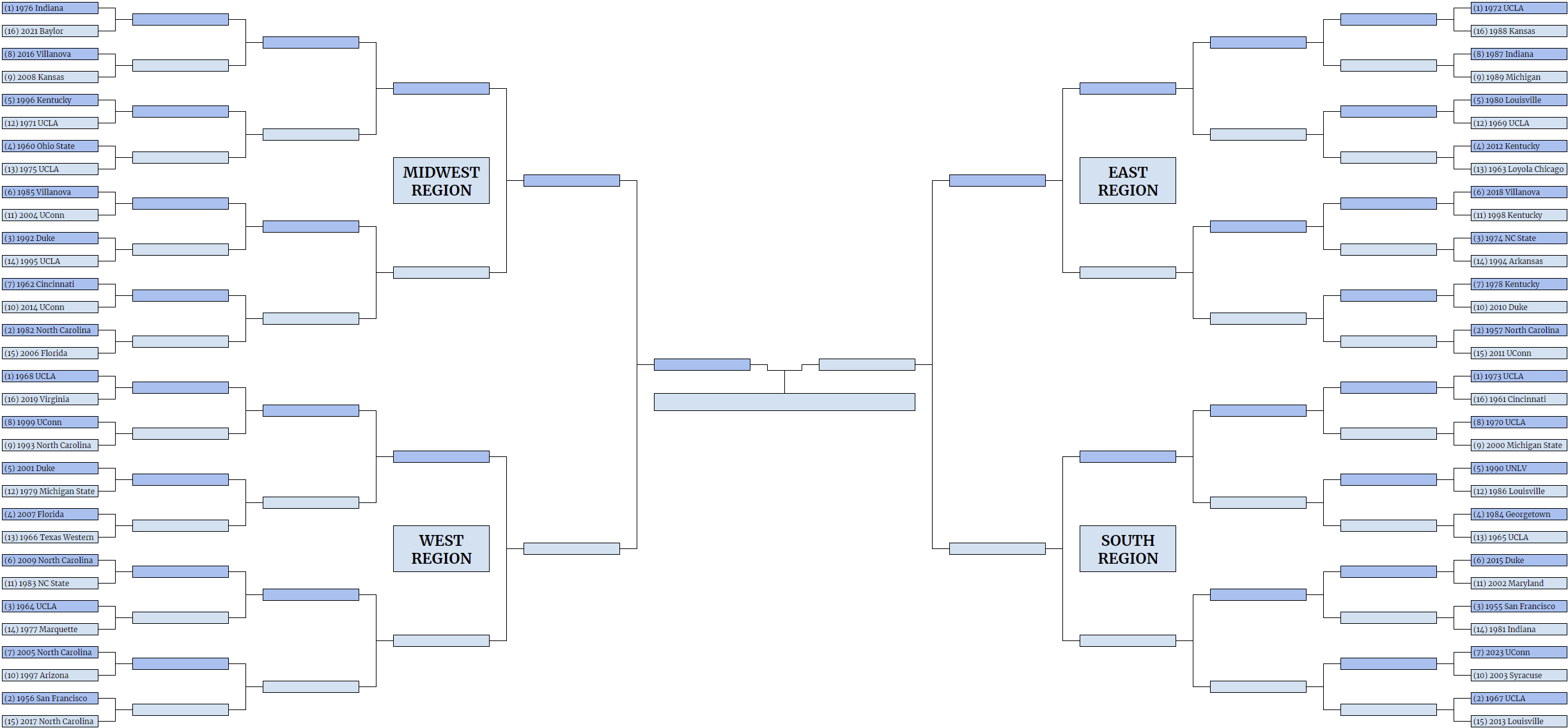
To download the Tournament of Champions bracket, please click here.
Seeding overview
In a tournament of legendary teams, UCLA secures three of the four No. 1 seeds and boasts the highest number of selections with 11 players in the field. However, the 1976 Indiana Hoosiers cause a surprise by clinching the top overall seed in the Tournament of Champions.
North Carolina, UConn, Duke, and Kentucky have joined UCLA as the only programs with at least four teams in the all-time bracket. Indiana, Louisville, and Villanova each have three teams in the tournament, while a total of 27 schools are represented with at least one contender in the Tournament of Champions.
First Four Out
- 1947 Holy Cross Crusaders
- 1959 California Golden Bears
- 1940 Indiana Hoosiers
- 1941 Wisconsin Badgers
Most controversial seeds
- 1957 North Carolina Tar Heels (2): It feels like the Tar Heels’ perfect 32-0 record really caught the committee’s attention, even with some serious luck needed to pull it off.
- 2007 Florida Gators (4): Most people don’t think of the Gators when rattling off the best teams in college basketball history, but the committee seems impressed with the NBA-caliber talent on display for the back-to-back champs.
- 1985 Villanova Wildcats (6): No team has ever won the title with a lower seed than Villanova, which is somehow slotted higher among champions than it was among its peers when it prevailed as a No. 8 seed.
- 1969 UCLA Bruins (12): It’s an unenviable task to rank John Wooden’s myriad title teams, but this feels particularly egregious by the committee. I’d hate to draw these Bruins as a higher-seeded team.
- 1966 Texas Western Miners (13): The Miners featured the first all-black starting lineup to ever win an NCAA title. Their reward? A bottom-four seed in the most loaded field of all-time.
Biggest tournament snubs
- 2026 Kansas Jayhawks: The Jayhawks are the most recent champions to miss the field and perhaps the most deserving of those on the bubble, though they did fall behind by 15 points at halftime of their own title win.
- 1948 Kentucky Wildcats: While none of Adolph Rupp’s four title winners are represented in this tournament, the ’48 team outscored opponents by 23.4 points per game — the best mark by any team not in the 64-team field.
- 1991 Duke Blue Devils: The ’92 team earned a top-three seed from the committee, but the ’91 team missed out entirely despite facing the ninth-toughest schedule of any former champion.
Worst team to ever win March Madness
The committee deemed the Utah NCAA Tournament champions as the least prestigious in history. Despite losing in the first round of the NIT Tournament in 1944 with a roster of local players, the “Blitz Kids” filled in for injured Arkansas starters and made history as a tournament replacement. However, 80 years later, their victory was labeled as the lowest-ranked champion.
Tournament of Champions Betting Odds
| Team (seed) | Title odds | Coach (record) | Top scorer (PPG) |
|---|---|---|---|
| ’72 UCLA Bruins (1) | +400 | John Wooden (30-0) | Bill Walton (21.1) |
| ’76 Indiana Hoosiers (1) | +450 | Bob Knight (32-0) | Scott May (23.5) |
| ’68 UCLA Bruins (1) | +550 | John Wooden (29-1) | Kareem Abdul-Jabbar (26.2) |
| ’73 UCLA Bruins (1) | +600 | John Wooden (30-0) | Bill Walton (20.4) |
| ’56 San Francisco Dons (2) | +700 | Phil Woolpert (29-0) | Bill Russell (20.6) |
| ’67 UCLA Bruins (2) | +700 | John Wooden (30-0) | Kareem Abdul-Jabbar (29.0) |
| ’82 North Carolina Tar Heels (2) | +800 | Dean Smith (32-2) | James Worthy (15.6) |
| ’92 Duke Blue Devils (3) | +850 | Mike Krzyzewski (34-2) | Christian Laettner (21.5) |
| ’07 Florida Gators (4) | +1200 | Billy Donovan (35-5) | Taurean Green (13.3) |
| ’12 Kentucky Wildcats (4) | +1200 | John Calipari (38-2) | Anthony Davis (14.2) |
| ’84 Georgetown Hoyas (4) | +1300 | John Thompson (34-3) | Patrick Ewing (16.4) |
| ’96 Kentucky Wildcats (5) | +1300 | Rick Pitino (34-2) | Tony Delk (17.8) |
| ’57 North Carolina Tar Heels (2) | +1500 | Frank McGuire (32-0) | Lennie Rosenbluth (28.0) |
| ’64 UCLA Bruins (3) | +1500 | John Wooden (30-0) | Gail Goodrich (21.5) |
| ’74 NC State Wolfpack (3) | +1800 | Norm Sloan (30-1) | David Thompson (26.0) |
| ’80 Louisville Cardinals (5) | +2000 | Denny Crum (33-3) | Darrell Griffith (22.9) |
| ’01 Duke Blue Devils (5) | +2200 | Mike Krzyzewski (35-4) | Jay Williams (21.6) |
| ’23 UConn Huskies (7) | +2500 | Dan Hurley (31-8) | Adama Sanogo (17.2) |
| ’85 Villanova Wildcats (6) | +2800 | Rollie Massimino (25-10) | Ed Pinckney (15.6) |
| ’55 San Francisco Dons (3) | +3000 | Phil Woolpert (28-1) | Bill Russell (21.4) |
| ’70 UCLA Bruins (8) | +3500 | John Wooden (28-2) | Sidney Wicks (18.6) |
| ’09 North Carolina Tar Heels (6) | +3500 | Roy Williams (34-4) | Tyler Hansbrough (20.7) |
| ’15 Duke Blue Devils (6) | +4000 | Mike Krzyzewski (35-4) | Jahlil Okafor (17.3) |
| ’18 Villanova Wildcats (6) | +4500 | Jay Wright (36-4) | Jalen Brunson (18.9) |
| ’60 Ohio State Buckeyes (4) | +5000 | Fred Taylor (25-3) | Jerry Lucas (26.3) |
1st round matchups
Midwest Region
1976 Indiana (1) vs. 2021 Baylor (16)
- Point spread: Indiana -8.5
- Moneyline: Indiana -320, Baylor +260
- Total O/U: 139.5
In this game, Baylor showcases a strong shooting and athleticism, spearheaded by future NBA players Davion Mitchell and Jared Butler. However, Indiana’s advantage in size, interior scoring, and top-notch perimeter defense overwhelms Baylor’s guard-heavy lineup, allowing them to stay undefeated with a final score of 73-60.
2016 Villanova (8) vs. 2008 Kansas (9)
- Point spread: Villanova -1
- Moneyline: Villanova -115, Kansas -105
- Total O/U: 139.5
Two teams that made history with their big shots in the NCAA Tournament faced off in the first round. Freshman Jalen Brunson came off the bench to score 12 points, including crucial free throws to seal a nail-biting victory over Kansas. Final score: Villanova 71, Kansas 68.
1996 Kentucky (5) vs. 1971 UCLA (12)
- Point spread: Kentucky -7
- Moneyline: Kentucky -270, UCLA +220
- Total O/U: 142.5
Kentucky’s depth and relentless pressure, led by nine future NBA players, proved too much for UCLA’s Sidney Wicks and Curtis Rowe in a gritty victory for “The Untouchables.” The final score was Kentucky 76, UCLA 71.
1960 Ohio State (4) vs. 1975 UCLA (13)
- Point spread: Ohio State -2.5
- Moneyline: Ohio State -140, UCLA +120
- Total O/U: 139.5
The Buckeyes have plenty of talent, evident even when facing Wooden’s championship-winning team. In the absence of Bill Walton or Kareem Abdul-Jabbar, sophomore Jerry Lucas dominates with 23 points and 20 rebounds, leading his team to a narrow victory. Ohio State defeats UCLA 74-70.
1985 Villanova (6) vs. 2004 UConn (11)
- Point spread: UConn -2
- Moneyline: UConn -130, Villanova +110
- Total O/U: 129.5
In the first round, the underdog Villanova was favored to win, but it was clear why that wasn’t the case. UConn’s Emeka Okafor scored 18 points and dominated the game with impressive dunks, leading the Huskies to a convincing 70-57 victory over Villanova, ending their storybook run.
1992 Duke (3) vs. 1995 UCLA (14)
- Point spread: Duke -6
- Moneyline: Duke -245, UCLA +205
- Total O/U: 147.5
Despite having six future pros, including Ed O’Bannon, this UCLA team is not as strong as the top seeds in the tournament. However, Duke managed to win comfortably with star scorer Christian Laettner leading the way with 21 points. Final score: Duke 82, UCLA 70.
1962 Cincinnati (7) vs. 2014 UConn (10)
- Point spread: Cincinnati -4.5
- Moneyline: Cincinnati -180, UConn +155
- Total O/U: 127.5
Shabazz Napier channeled his inner Kemba Walker during the 2014 tournament, but his impressive performance comes to an end against Cincinnati. The physical game wears down Napier, limiting him to just 13 points as Cincinnati edges out UConn in a close 63-60 victory.
1982 North Carolina (2) vs. 2006 Florida (15)
- Point spread: North Carolina -6.5
- Moneyline: North Carolina -260, Florida +220
- Total O/U: 145.5
Despite having several future Hall of Famers on the court, North Carolina almost squanders a double-digit halftime lead before freshman Michael Jordan steps up with 17 points in the end. Florida’s Corey Brewer’s missed three-pointer at the buzzer seals the victory for North Carolina in a thrilling first-round game, with a final score of 74-72.
Midwest Region scores and betting recap
| Result | ATS | ML | O/U |
|---|---|---|---|
| Indiana 73, Baylor 60 | Indiana -8.5 | Indiana -320 | Under 139.5 |
| Villanova 71, Kansas 68 | Villanova -1 | Villanova -115 | Under 139.5 |
| Kentucky 76, UCLA 71 | UCLA +7 | Kentucky -270 | Over 142.5 |
| Ohio State 74, UCLA 70 | Ohio State -2.5 | Ohio State -140 | Over 139.5 |
| UConn 70, Villanova 57 | UConn -2 | UConn -130 | Under 129.5 |
| Duke 82, UCLA 70 | Duke -6 | Duke -245 | Over 147.5 |
| Cincinnati 63, UConn 60 | UConn +4.5 | Cincinnati -180 | Under 127.5 |
| North Carolina 74, Florida 72 | Florida +6.5 | North Carolina -260 | Over 145.5 |
East Region
1972 UCLA (1) vs. 1988 Kansas (16)
- Point spread: UCLA -11
- Moneyline: UCLA -440, Kansas +350
- Total O/U: 142.5
The ’72 Bruins are the clear favorites of the first round for a reason. Walton’s impressive 31-point performance outshines Manning’s 18 points in a statement victory for the overall tournament favorite. UCLA dominates Kansas with a final score of 85-64.
1987 Indiana (8) vs. 1989 Michigan (9)
- Point spread: Indiana -2.5
- Moneyline: Indiana -140, Michigan +120
- Total O/U: 143.5
In 1989, Michigan boasted a talented lineup led by Glen Rice, a top scorer. Rice’s impressive shooting skills challenged Indiana’s strong defense, leading Michigan to a 75-71 victory in an upset over the Hoosiers, before the arrival of the Fab Five.
1980 Louisville (5) vs. 1969 UCLA (12)
- Point spread: Louisville -3
- Moneyline: Louisville -155, UCLA +135
- Total O/U: 133.5
In 1980, Louisville had six future professional players, including top-three picks Darrell Griffith and Rodney McCray. However, UCLA’s incredibly talented roster in 1969 proved to be too much for Louisville in the tournament. The underseeded UCLA team dominated in the paint and pulled off an “upset” victory with a final score of UCLA 72, Louisville 64.
2012 Kentucky (4) vs. 1963 Loyola Chicago (13)
- Point spread: Kentucky -10
- Moneyline: Kentucky -400, Loyola Chicago +330
- Total O/U: 143.5
While Jerry Harkness, Les Hunter, and the rest of the groundbreaking Ramblers team deserve respect, they have never faced a player like Anthony Davis (22 points, seven blocks). Davis and teammate Doron Lamb (18 points) lead the Wildcats to an easy win in the first round. Final score: Kentucky 77, Loyola Chicago 62.
2018 Villanova (6) vs. 1998 Kentucky (11)
- Point spread: Villanova -6.5
- Moneyline: Villanova -260, Kentucky +210
- Total O/U: 145.5
Villanova revolutionized basketball in 2018 with their cutting-edge style, overwhelming the “Comeback Cats” with their elite shooting and ball movement. The high-scoring game exposed Kentucky’s supersized frontcourt, resulting in a final score of Villanova 86, Kentucky 76.
1974 NC State (3) vs. 1994 Arkansas (14)
- Point spread: NC State -4.5
- Moneyline: NC State -190, Arkansas +165
- Total O/U: 150.5
Nolan Richardson’s aggressive “40 Minutes of Hell” strategy initially rattles NC State, but the team that dethroned UCLA after seven years puts up a strong fight. David Thompson, leading with 26 points, scores the crucial basket with only 4.6 seconds remaining to secure a victory for the ‘Pack. Final score: NC State 82, Arkansas 80.
1978 Kentucky (7) vs. 2010 Duke (10)
- Point spread: Kentucky -5
- Moneyline: Kentucky -210, Duke +175
- Total O/U: 138.5
In 2010, the Blue Devils were unstoppable with three players averaging 17 PPG and seven future pros on the team. Despite Jack Givens’ impressive 33 points for the Wildcats, Duke’s hot shooting from beyond the arc led them to a 79-74 victory.
1957 North Carolina (2) vs. 2011 UConn (15)
- Point spread: North Carolina -4
- Moneyline: North Carolina -175, UConn +155
- Total O/U: 131.5
UNC needed six overtimes in the Final Four, led by Lennie Rosenbluth, to complete a perfect 32-0 season in ’57. In contrast, Kemba Walker’s step-back jumper at the buzzer was all it took for Connecticut to cause a major upset in the first round, defeating North Carolina 64-62 with 25 points.
East Region scores and betting recap
| Result | ATS | ML | O/U |
|---|---|---|---|
| UCLA 85, Kansas 64 | UCLA -11 | UCLA -440 | Over 142.5 |
| Michigan 75, Indiana 71 | Michigan +2.5 | Michigan +120 | Over 143.5 |
| UCLA 72, Louisville 64 | UCLA +3 | UCLA +135 | Over 133.5 |
| Kentucky 77, Loyola Chicago 62 | Kentucky -10 | Kentucky -400 | Under 143.5 |
| Villanova 86, Kentucky 76 | Villanova -6.5 | Villanova -260 | Over 145.5 |
| NC State 82, Arkansas 80 | Arkansas +4.5 | NC State -190 | Over 150.5 |
| Duke 79, Kentucky 74 | Duke +5 | Duke +175 | Over 138.5 |
| UConn 64, North Carolina 62 | UConn +4 | UConn +155 | Under 131.5 |
South Region
1973 UCLA (1) vs. 1961 Cincinnati (16)
- Point spread: UCLA -9.5
- Moneyline: UCLA -400, Cincinnati +320
- Total O/U: 136.5
If Oscar Robertson was still playing for the Bearcats, this matchup would have been more intriguing. However, Paul Hogue (19 points) and Bob Wiesenhahn (13) help keep Cincinnati close before Bill Walton (26) seals the victory for the Bruins. Final score: UCLA 74, Cincinnati 65.
1970 UCLA (8) vs. 2000 Michigan State (9)
- Point spread: UCLA -3
- Moneyline: UCLA -150, Michigan State +130
- Total O/U: 135.5
The highly anticipated coaching showdown between Wooden and Tom Izzo lives up to expectations. Michigan State’s physical play disrupts UCLA’s ball movement, resulting in the lowest-scoring game of the first round. The Spartans come out on top with a final score of 57-54 over UCLA.
1990 UNLV (5) vs. 1986 Louisville (12)
- Point spread: UNLV -6
- Moneyline: UNLV -240, Louisville +200
- Total O/U: 146.5
The current UNLV team falls short in comparison to the undefeated ’91 team that reached the Final Four. Despite this, Louisville is unable to match up against Jerry Tarkanian’s fast-paced Runnin’ Rebels in a lopsided victory. Final score: UNLV 85, Louisville 68.
1984 Georgetown (4) vs. 1965 UCLA (13)
- Point spread: Georgetown -4.5
- Moneyline: Georgetown -180, UCLA +160
- Total O/U: 130.5
In this tournament, any team with a Wooden-coached is a formidable opponent. However, not even the best coach of all time can find a solution for Patrick Ewing, who dominated with 15 points, 13 rebounds, and four blocks in a tough victory for the Hoyas. Final score: Georgetown 66, UCLA 61.
2015 Duke (6) vs. 2002 Maryland (11)
- Point spread: Duke -4
- Moneyline: Duke -175, Maryland +150
- Total O/U: 144.5
Maryland may not have the same star power as other teams in the tournament, but seniors Juan Dixon and Lonny Baxter lead them to victory over the talented but inexperienced Blue Devils in a thrilling first-round match. Final score: Maryland 78, Duke 73.
1955 San Francisco (3) vs. 1981 Indiana (14)
- Point spread: San Francisco -5.5
- Moneyline: San Francisco -210, Indiana +175
- Total O/U: 134.5
One could make the case that the San Francisco team of today is superior to the undefeated team of 1956. Bill Russell’s dominant performance (25 points, 13 rebounds, seven blocks) in the paint helped lead the Dons to a decisive victory over the Hoosiers, with Isiah Thomas struggling to score (four buckets) and committing more turnovers (five) in the lopsided game. The final score was San Francisco 72, Indiana 56.
2026 UConn (7) vs. 2003 Syracuse (10)
- Point spread: UConn -1.5
- Moneyline: UConn -120, Syracuse +100
- Total O/U: 131.5
Connecticut, who had been dominant in the 2026 tournament, struggled against Syracuse’s 2-3 zone defense, leading to a cold shooting spell. Carmelo Anthony led the Orange with a game-high 26 points, 16 of which came in the second half, propelling Syracuse to victory with a final score of 73-67 over UConn.
1967 UCLA (2) vs. 2013 Louisville (15)
- Point spread: UCLA -5.5
- Moneyline: UCLA -220, Louisville +180
- Total O/U: 137.5
The Louisville press was a challenge for teams in the 2013 tournament, but Wooden had his team ready. Abdul-Jabbar had an impressive performance with 30 points and 21 rebounds, leading the Bruins to a convincing 75-60 victory over Louisville.
South Region scores and betting recap
| Result | ATS | ML | O/U |
|---|---|---|---|
| UCLA 74, Cincinnati 65 | Cincinnati +9.5 | UCLA -400 | Over 136.5 |
| Michigan State 57, UCLA 54 | Michigan State +3 | Michigan State +130 | Under 135.5 |
| UNLV 85, Louisville 68 | UNLV -6 | UNLV -240 | Over 146.5 |
| Georgetown 66, UCLA 61 | Georgetown -4.5 | Georgetown -180 | Under 130.5 |
| Maryland 78, Duke 73 | Maryland +4 | Maryland +150 | Over 144.5 |
| San Francisco 72, Indiana 56 | San Francisco -5.5 | San Francisco -210 | Under 134.5 |
| Syracuse 73, UConn 67 | Syracuse +1.5 | Syracuse +100 | Over 131.5 |
| UCLA 75, Louisville 60 | UCLA -5.5 | UCLA -220 | Under 137.5 |
West Region
1968 UCLA (1) vs. 2019 Virginia (16)
- Point spread: UCLA -7
- Moneyline: UCLA -280, Virginia +240
- Total O/U: 125.5
No. 16 seed Virginia had No. 1 seed UCLA on the brink of an upset until Abdul-Jabbar’s 23 points in the second half broke through the Cavaliers’ pack-line defense. UCLA narrowly avoided a monumental upset with a final score of 63-58.
1999 UConn (8) vs. 1993 North Carolina (9)
- Point spread: UConn -2.5
- Moneyline: UConn -135, North Carolina +115
- Total O/U: 141.5
UConn’s Richard Hamilton, the game’s top shot-maker, led his team to a 74-72 victory over North Carolina with 28 points, including the go-ahead basket with six seconds remaining. This win avenged a previous Elite Eight loss to UNC and showcased the Huskies’ ability to overcome the advantage North Carolina had inside.
2001 Duke (5) vs. 1979 Michigan State (12)
- Point spread: Duke -5.5
- Moneyline: Duke -225, Michigan State +185
- Total O/U: 139.5
In 2001, Duke had a talented team but lacked a player of Magic Johnson’s caliber. Johnson, fresh off defeating Larry Bird in the 1979 final, led Michigan State to an upset victory with a 30-point triple-double in the tournament’s opening round. The final score was Michigan State 75, Duke 70.
2007 Florida (4) vs. 1966 Texas Western (13)
- Point spread: Florida -7
- Moneyline: Florida -275, Texas Western +230
- Total O/U: 139.5
The Miners’ 1966 championship journey is considered one of the greatest tales in college basketball history, but it was Florida’s dominant performance, led by Al Horford and Joakim Noah among other future NBA players, that ultimately resulted in a decisive victory. Florida triumphed over Texas Western with a final score of 75-59.
2009 North Carolina (6) vs. 1983 NC State (11)
- Point spread: North Carolina -4.5
- Moneyline: North Carolina -190, NC State +160
- Total O/U: 148.5
NC State’s remarkable journey in the 1983 tournament is legendary, but not even a motivational halftime talk from Jim Valvano can help the “Cardiac Pack” defeat Tyler Hansbrough (22 points, 12 rebounds) and the talented UNC team. North Carolina wins 85-75.
1964 UCLA (3) vs. 1977 Marquette (14)
- Point spread: UCLA -6.5
- Moneyline: UCLA -250, Marquette +210
- Total O/U: 141.5
The current Bruins team may not have the same level of star talent as past teams coached by Wooden, but Gail Goodrich and Walt Hazzard still lead the way with a combined 45 points in a solid victory over Al McGuire’s last Marquette squad. Final score: UCLA 75, Marquette 67.
2005 North Carolina (7) vs. 1997 Arizona (10)
- Point spread: North Carolina -3.5
- Moneyline: North Carolina -165, Arizona +145
- Total O/U: 147.5
Lute Olson’s resilient team is known for causing upsets in tournaments, but UNC’s talented roster proves too much for Arizona to handle. Sean May scores 23 points, Marvin Williams adds 16, and Raymond Felton contributes 14 in a balanced effort. North Carolina defeats Arizona 79-72.
1956 San Francisco (2) vs. 2017 North Carolina (15)
- Point spread: San Francisco -6.5
- Moneyline: San Francisco -265, North Carolina +225
- Total O/U: 138.5
The Tar Heels’ redemption fueled their title run in 2017. However, poor shooting from three-point range (5-of-25) led to their downfall against Russell and his team in a tense first-round game. The Dons emerged victorious with a score of 70-63 over North Carolina.
West Region scores and betting recap
| Result | ATS | ML | O/U |
|---|---|---|---|
| UCLA 63, Virginia 58 | Virginia +7 | UCLA -280 | Under 125.5 |
| UConn 74, North Carolina 72 | North Carolina +2.5 | UConn -135 | Over 141.5 |
| Michigan State 75, Duke 70 | Michigan State +5.5 | Michigan State +185 | Over 139.5 |
| Florida 75, Texas Western 59 | Florida -7 | Florida -275 | Under 139.5 |
| North Carolina 85, NC State 75 | North Carolina -4.5 | North Carolina -190 | Over 148.5 |
| UCLA 75, Marquette 67 | UCLA -6.5 | UCLA -250 | Over 141.5 |
| North Carolina 79, Arizona 72 | North Carolina -3.5 | North Carolina -165 | Over 147.5 |
| San Francisco 70, North Carolina 63 | San Francisco -6.5 | San Francisco -265 | Under 138.5 |
2nd round matchups
Midwest Region
1976 Indiana (1) vs. 2016 Villanova (8)
- Point spread: Indiana -4.5
- Moneyline: Indiana -200, Villanova +170
- Total O/U: 142.5
Villanova impresses oddsmakers with a strong first half against the No. 1 overall seed, but Indiana’s defense ultimately prevails. Despite Josh Hart and Kris Jenkins’ solid performances, Indiana’s Kent Benson leads his team to victory with 21 points in the end. Final score: Indiana 76, Villanova 70.
1960 Ohio State (4) vs. 1996 Kentucky (5)
- Point spread: Kentucky -3.5
- Moneyline: Kentucky -160, Ohio State +140
- Total O/U: 145.5
Kentucky overcomes a double-digit halftime deficit to defeat Ohio State 76-73 in a thrilling second-round matchup. Lucas leads Ohio State with 18 points at halftime, but Rick Pitino’s team forces 14 second-half turnovers to secure a spot in the Sweet 16.
1992 Duke (3) vs. 2004 UConn (11)
- Point spread: Duke -2.5
- Moneyline: Duke -140, UConn +120
- Total O/U: 147.5
Duke’s typically strong defense faces a major challenge from UConn’s athleticism, particularly in the frontcourt. However, the Blue Devils’ offensive firepower, spearheaded by Grant Hill with 24 points and Laettner with 19, proves too much for the Huskies to handle. Final score: Duke 81, UConn 70.
1982 North Carolina (2) vs. 1962 Cincinnati (7)
- Point spread: North Carolina -5
- Moneyline: North Carolina -210, Cincinnati +175
- Total O/U: 139.5
Jordan and James Worthy led UNC to a wire-to-wire victory over the Bearcats in the second round after a brief scare in the first round. North Carolina won 77-66, with Jordan scoring 21 points and Worthy adding 19.
Midwest Region scores and betting recap
| Result | ATS | ML | O/U |
|---|---|---|---|
| Indiana 76, Villanova 70 | Indiana -4.5 | Indiana -200 | Over 142.5 |
| Kentucky 76, Ohio State 73 | Ohio State +3.5 | Kentucky -160 | Over 145.5 |
| Duke 81, UConn 70 | Duke -2.5 | Duke -140 | Over 147.5 |
| North Carolina 77, Cincinnati 66 | North Carolina -5 | North Carolina -210 | Over 139.5 |
East Region
1972 UCLA (1) vs. 1989 Michigan (9)
- Point spread: UCLA -8
- Moneyline: UCLA -340, Michigan +280
- Total O/U: 144.5
Rice scores 24 points to keep Michigan’s title hopes alive, but Walton’s 26 points and eight blocks help UCLA secure an 80-70 victory in a closely contested game.
2012 Kentucky (4) vs. 1969 UCLA (12)
- Point spread: Kentucky -2
- Moneyline: Kentucky -130, UCLA +110
- Total O/U: 137.5
Davis is perhaps the sole player capable of challenging Abdul-Jabbar’s sky hook. His strong defense in the paint, combined with the Wildcats’ size on the perimeter, proves to be too much for the talented Bruins in a thrilling victory for John Calipari’s team. Final score: Kentucky 67, UCLA 64.
1974 NC State (3) vs. 2018 Villanova (6)
- Point spread: Villanova -1.5
- Moneyline: Villanova -125, NC State +105
- Total O/U: 141.5
NC State faces a challenging match-up as they typically rely on their 7-2 center Tom Burleson for an advantage inside. However, Villanova’s strong shooting from long range proves to be a problem for NC State in this game. Despite a stellar performance from Thompson with 32 points, Villanova manages to come out on top with a 78-73 victory.
2010 Duke (10) vs. 2011 UConn (15)
- Point spread: Duke -4
- Moneyline: Duke -180, UConn +160
- Total O/U: 139.5
March Madness wouldn’t be complete without lower-seeded teams battling it out for a spot in the Sweet 16, and that’s exactly what happened when Duke’s defense held Connecticut to just one 3-pointer. However, Connecticut’s Walker scored 29 points and led his team to victory, advancing as the beloved underdogs of the tournament. The final score was UConn 68, Duke 66.
East Region scores and betting recap
| Result | ATS | ML | O/U |
|---|---|---|---|
| UCLA 80, Michigan 70 | UCLA -8 | UCLA -340 | Over 144.5 |
| Kentucky 67, UCLA 64 | Kentucky -2 | Kentucky -130 | Under 137.5 |
| Villanova 78, NC State 73 | Villanova -1.5 | Villanova -125 | Over 141.5 |
| UConn 68, Duke 66 | UConn +4 | UConn +160 | Under 139.5 |
South Region
1973 UCLA (1) vs. 2000 Michigan State (9)
- Point spread: UCLA -7
- Moneyline: UCLA -280, Michigan State +240
- Total O/U: 134.5
Michigan State was able to defeat one UCLA team in Round 1, but the dominant performance by Walton with 27 points and 17 rebounds proved to be the deciding factor as the unbeaten Bruins secured a comfortable second-round victory over Michigan State, with a final score of 72-61.
1984 Georgetown (4) vs. 1990 UNLV (5)
- Point spread: UNLV -2
- Moneyline: UNLV -130, Georgetown +110
- Total O/U: 142.5
Georgetown’s 7-foot big man had a tough time against UNLV’s fast-paced team, resulting in a high-energy win for the Runnin’ Rebels. Larry Johnson scored 23 points as they wore down the Hoyas’ big man. Final score: UNLV 79, Georgetown 73.
1955 San Francisco (3) vs. 2002 Maryland (11)
- Point spread: San Francisco -3
- Moneyline: San Francisco -150, Maryland +130
- Total O/U: 131.5
Maryland pulled off a stunning upset over ACC rival Duke in the opening round, but their flex offense couldn’t handle San Francisco’s dominant defense led by Russell, who blocked 11 shots. San Francisco cruised to the Sweet 16 with a 68-57 victory over Maryland.
1967 UCLA (2) vs. 2003 Syracuse (10)
- Point spread: UCLA -5.5
- Moneyline: UCLA -220, Syracuse +180
- Total O/U: 136.5
Anthony rose to the challenge of the historic test, scoring 35 points on 23 shots. However, Abdul-Jabbar excelled in exploiting the 2-3 zone, and UCLA’s Lucius Allen’s late key shots propelled them to victory over Syracuse in the second round, with a final score of UCLA 75, Syracuse 71.
South Region scores and betting recap
| Result | ATS | ML | O/U |
|---|---|---|---|
| UCLA 72, Michigan State 61 | UCLA -7 | UCLA -280 | Under 134.5 |
| UNLV 79, Georgetown 73 | UNLV -2 | UNLV -130 | Over 142.5 |
| San Francisco 68, Maryland 57 | San Francisco -3 | San Francisco -150 | Under 131.5 |
| UCLA 75, Syracuse 71 | Syracuse +5.5 | UCLA -220 | Over 136.5 |
West Region
1968 UCLA (1) vs. 1999 UConn (8)
- Point spread: UCLA -6.5
- Moneyline: UCLA -260, UConn +220
- Total O/U: 135.5
After a strong performance in the first round, Hamilton (16 points) struggles to find their rhythm against UCLA. UCLA maintains a double-digit lead at halftime and secures a dominant victory over an outmatched Connecticut team. Final score: UCLA 74, UConn 58.
2007 Florida (4) vs. 1979 Michigan State (12)
- Point spread: Florida -3.5
- Moneyline: Florida -160, Michigan State +140
- Total O/U: 140.5
Michigan State’s lack of height in the frontcourt is a concern against Florida, but Magic Johnson, standing at 6-8, comes through with his second triple-double of the tournament. His clutch assist to Greg Kelser (23 points) with 1.1 seconds remaining secures a thrilling victory for Michigan State over Florida, with a final score of 71-69.
1964 UCLA (3) vs. 2009 North Carolina (6)
- Point spread: UCLA -1
- Moneyline: UCLA -120, North Carolina +100
- Total O/U: 143.5
Despite the absence of Abdul-Jabbar or Walton, UCLA still had a strong team with future All-Stars Goodrich and Hazzard. The Bruins struggled with size against Hansbrough and the relentless guards of North Carolina, leading to a close game. Ultimately, UNC narrowly defeated UCLA with a score of 78-74.
1956 San Francisco (2) vs. 2005 North Carolina (7)
- Point spread: San Francisco -2.5
- Moneyline: San Francisco -130, North Carolina +110
- Total O/U: 138.5
An elite defensive center like Russell is the most effective way to stop May and the Tar Heels. However, without star guard K.C. Jones available for the postseason, North Carolina’s trio of Felton (19 points), Williams (17), and Rashad McCants (14) prove to be too formidable for the NCAA’s first undefeated champion to defeat. The final score is North Carolina 68, San Francisco 65.
West Region scores and betting recap
| Result | ATS | ML | O/U |
|---|---|---|---|
| UCLA 74, UConn 58 | UCLA -6.5 | UCLA -260 | Under 135.5 |
| Michigan State 71, Florida 69 | Michigan State +3.5 | Michigan State +140 | Under 140.5 |
| North Carolina 78, UCLA 74 | North Carolina +1 | North Carolina +100 | Over 143.5 |
| North Carolina 68, San Francisco 65 | North Carolina +2.5 | North Carolina +110 | Under 138.5 |
Sweet 16 matchups
Midwest Region
1976 Indiana (1) vs. 1996 Kentucky (5)
- Point spread: Indiana -2
- Moneyline: Indiana -130, Kentucky +110
- Total O/U: 148.5
Like many other Sweet 16 games, this matchup is sure to delight college basketball enthusiasts.
Indiana takes an early lead behind strong performances from Scott May (23 points) and Benson (20), but Antoine Walker (17 points, 10 rebounds, seven assists) keeps Kentucky in the game. However, as the second half progresses, Indiana’s offense begins to struggle against Kentucky’s aggressive defense.
With just a one-point lead and possession of the ball with only 10 seconds remaining, Indiana’s Quinn Buckner makes a critical mistake with an errant pass. This leads to chaos on the opposite end of the court, where Wildcats senior Tony Delk, who scored 21 points, sinks a difficult 15-foot shot just as time expires. This shot results in the tournament’s No. 1 overall seed being defeated, with Kentucky winning by a score of 71-70 against Indiana.
1982 North Carolina (2) vs. 1992 Duke (3)
- Point spread: North Carolina -1.5
- Moneyline: North Carolina -125, Duke +105
- Total O/U: 155.5
One could make the case that these teams are among the greatest in the history of the Tobacco Road rivalry, and both are sure to put up a fight.
The Tar Heels take an early lead in the historic game, led by a dominant performance from Worthy who scores 27 points, 16 of which come in the first half. The Blue Devils mount a strong comeback with Laettner scoring 23 points and Hill adding 17, both shooting over 50% from the field by the end of the game.
Ultimately, it was the underrated player Sam Perkins (15) who was left unguarded in the corner as the game was winding down. The big man from UNC coolly made a 3-pointer, his first ever under the tournament’s updated rules, to seal the second most significant victory in the history of the rivalry. The final score was North Carolina 82, Duke 79.
Midwest Region scores and betting recap
| Result | ATS | ML | O/U |
|---|---|---|---|
| Kentucky 71, Indiana 70 | Kentucky +2 | Kentucky +110 | Under 148.5 |
| North Carolina 82, Duke 79 | North Carolina -1.5 | North Carolina -125 | Over 155.5 |
East Region
1972 UCLA (1) vs. 2012 Kentucky (4)
- Point spread: UCLA -5.5
- Moneyline: UCLA -220, Kentucky +180
- Total O/U: 143.5
Just five days after facing Abdul-Jabbar, Davis is now assigned the challenge of guarding Walton, a freshman who is already being considered one of the greatest players in college basketball history. It quickly becomes apparent that the Wooden Award winner is more than capable of holding his own against this legendary opponent.
Kentucky’s 6-10 standout player utilizes his incredible 7-6 wingspan to disrupt Walton on defense and draw the UCLA big man out to the perimeter, creating opportunities for guards Doron Lamb (21 points) and Marquis Teague (13) to attack the paint.
Wooden implemented a 2-2-1 zone defense to try to control the Wildcats’ pace and keep Walton close to the basket. However, Davis, a former high school point guard, shines with seven assists in an impressive performance. UCLA makes a late comeback, but Bibby’s last-second shot is off target, leading to an early exit for one of the top teams in history. Kentucky wins 70-67.
2018 Villanova (6) vs. 2011 UConn (15)
- Point spread: Villanova -4
- Moneyline: Villanova -180, UConn +160
- Total O/U: 149.5
At times, big-time moments are won by great teams, while other times it’s great players who shine. Walker has shown himself to be the latter, as the Huskies’ dynamic guard adds to his impressive tournament performance with 11 assists in the game. Freshmen teammates Jeremy Lamb (22 points) and Napier (12) step up to lead the scoring effort.
UConn’s inspired defense stuns Villanova as they go cold from beyond the arc, allowing the lowest-seeded team to prevail once more. Final score: UConn 76, Villanova 72.
East Region scores and betting recap
| Result | ATS | ML | O/U |
|---|---|---|---|
| Kentucky 70, UCLA 67 | Kentucky +5.5 | Kentucky +180 | Under 143.5 |
| UConn 76, Villanova 72 | UConn +4 | UConn +160 | Under 149.5 |
South Region
1973 UCLA (1) vs. 1990 UNLV (5)
- Point spread: UCLA -2.5
- Moneyline: UCLA -140, UNLV +120
- Total O/U: 152.5
From the very start, it appears that the Runnin’ Rebels are poised to swiftly take control of the game, thanks to some early mistakes by UCLA forward Jamaal Wilkes that ignite a strong beginning for Tarkanian’s team.
After settling in, Walton asserts himself and dominates against UNLV’s smaller frontcourt, leading the Bruins to a commanding victory. The 6-11 standout records 33 points and 17 rebounds, securing a double-digit win for UCLA over UNLV, with a final score of 84-72.
1967 UCLA (2) vs. 1955 San Francisco (3)
- Point spread: UCLA -1
- Moneyline: UCLA -120, San Francisco +100
- Total O/U: 137.5
When San Francisco made it to the national title game in 1955, they had significantly improved since their loss to UCLA earlier in the season. Russell’s impressive performance of 26 points and 17 rebounds was a major factor in their success, as he made it difficult for Abdul-Jabbar to score from the very beginning of the Sweet 16 matchup.
Jones, with his relentless pressure, annoys Allen and Mike Warren in the Bruins’ backcourt and also contributes 18 points and six assists as the Dons’ point guard. Thanks to Jones’ performance, San Francisco manages to secure a narrow upset victory against UCLA, with a final score of 65-63.
South Region scores and betting recap
| Result | ATS | ML | O/U |
|---|---|---|---|
| UCLA 84, UNLV 72 | UCLA -2.5 | UCLA -140 | Over 152.5 |
| San Francisco 65, UCLA 63 | San Francisco +1 | San Francisco +100 | Under 137.5 |
West Region
1968 UCLA (1) vs. 1979 Michigan State (12)
- Point spread: UCLA -6
- Moneyline: UCLA -250, Michigan State +210
- Total O/U: 141.5
The focus of this matchup is largely on the anticipated showdown between Abdul-Jabbar and his upcoming teammate, Magic Johnson, whose impressive triple-double streak has been crucial in leading Michigan State to this stage of the tournament.
As anticipated, the two players step up and score a total of 61 points in a performance reminiscent of “Showtime.” However, UCLA junior Lynn Shackelford shines the brightest by sinking five three-pointers in the new format, leading the Bruins to a 78-71 victory over Michigan State despite a late comeback attempt by the Spartans.
2009 North Carolina (6) vs. 2005 North Carolina (7)
- Point spread: ’09 North Carolina -1.5
- Moneyline: ’09 North Carolina -125, ’05 North Carolina +105
- Total O/U: 162.5
If these odds were available in person, this game would break North Carolina sports betting records. The on-court matchups are so exciting that they would make any basketball fan salivate.
May and Hansbrough are the leading scorers with 26 and 23 points respectively, while Felton and Ty Lawson provide six and eight assists, setting the stage for a star-studded game. The 2005 team takes an early lead, but Lawson and Ellington’s outside shots help the 2009 team surge ahead in the end.
The true hero of the game is Danny Green, a fan favorite, who blocks McCants in the closing moments to propel Roy Williams’ second championship team to the Elite Eight. With this crucial play, Green not only secures victory for the ’09 North Carolina team but also earns them the ultimate bragging rights over the ’05 North Carolina team. The final score: ’09 North Carolina 87, ’05 North Carolina 85.
West Region scores and betting recap
| Result | ATS | ML | O/U |
|---|---|---|---|
| UCLA 78, Michigan State 71 | UCLA -6 | UCLA -250 | Over 141.5 |
| ’09 North Carolina 87, ’05 North Carolina 85 | ’09 North Carolina -1.5 | ’09 North Carolina -125 | Over 162.5 |
Elite Eight matchups
Midwest Regional Final
1982 North Carolina (2) vs. 1996 Kentucky (5)
- Point spread: North Carolina -1
- Moneyline: North Carolina -120, Kentucky +100
- Total O/U: 153.5
Smith’s Tar Heels were able to control the tempo early in the game to prevent turnovers and limit opponent shooters, focusing on funneling the action inside after observing Kentucky’s strong defensive performances in their previous games.
Indeed, Walker (17 points), Delk (14 points), and senior forward Walter McCarty (13) step up to support the talented Wildcats. However, Worthy (29) dominates the game and leads UNC to a close victory. Final score: North Carolina 78, Kentucky 73.
East Regional Final
2012 Kentucky (4) vs. 2011 UConn (15)
- Point spread: Kentucky -4.5
- Moneyline: Kentucky -185, UConn +165
- Total O/U: 137.5
The Huskies’ impressive performance in the Elite Eight has earned them respect from oddsmakers, despite being a No. 15 seed in the tournament. It’s easy to see why, with Walker’s exceptional play in three consecutive games building on his legendary run in 2011.
Kentucky’s length disrupts UConn’s guards and takes advantage of their lack of a reliable center, leading to a workmanlike win for the ‘Cats with Davis scoring 19 points and Jones adding 17. The final score is Kentucky 76, UConn 65.
South Regional Final
1973 UCLA (1) vs. 1955 San Francisco (3)
- Point spread: UCLA -4
- Moneyline: UCLA -170, San Francisco +150
- Total O/U: 129.5
Russell and Jones have already joined forces to defeat one UCLA team. So, why not try to take down another? The ’73 team presents a tougher challenge with Walton playing at his peak, but the Bruins do not have their usual rebounding advantage with Russell grabbing 21 rebounds and capitalizing on second-chance opportunities.
Jones once again showcases his impact on both offense and defense with 11 points, eight rebounds, seven assists, and four steals, leading San Francisco to victory over UCLA 68-64. Despite Walton’s impressive 32-point performance, San Francisco advances to the Final Four.
West Regional Final
1968 UCLA (1) vs. 2009 North Carolina (6)
- Point spread: UCLA -3
- Moneyline: UCLA -150, North Carolina +130
- Total O/U: 145.5
North Carolina has already defeated one team coached by Wooden in the Round of 32, but Hansbrough and his teammates have yet to face a challenge as formidable as this UCLA squad.
Abdul-Jabbar, who had previously faced off against Magic Johnson in the Sweet 16, continues to impress with another 30-point performance. Despite North Carolina’s attempts to shake things up by bringing in freshmen bigs Tyler Zeller (7-0) and Ed Davis (6-10), Abdul-Jabbar remains dominant with six blocks on defense. This ultimately leads to UCLA defeating North Carolina 74-68 and crushing their hopes of winning the all-time title.
Elite Eight scores and betting recap
| Result | ATS | ML | O/U |
|---|---|---|---|
| North Carolina 78, Kentucky 73 | North Carolina -1 | North Carolina -120 | Under 153.5 |
| Kentucky 76, UConn 65 | Kentucky -4.5 | Kentucky -185 | Over 137.5 |
| San Francisco 68, UCLA 64 | San Francisco +4 | San Francisco +150 | Over 129.5 |
| UCLA 74, North Carolina 68 | UCLA -3 | UCLA -150 | Under 145.5 |
Final Four matchups
1968 UCLA (1) vs. 1982 North Carolina (2)
- Point spread: UCLA -2.5
- Moneyline: UCLA -140, North Carolina +120
- Total O/U: 149.5
This Final Four showdown has all the elements fans dream of: iconic players destined for the Hall of Fame, renowned coaches, and two of the most reliable performers in college basketball history.
Smith praised the UCLA team as the best basketball team in history after they defeated North Carolina by 23 points in the ’68 final. He witnessed firsthand the exceptional skills of Abdul-Jabbar, whom he deemed as the greatest player to ever play the game, after he scored 34 points and grabbed 16 rebounds in the NCAA title game.
He continues his impressive performance in this game, leading all scorers with 26 points, grabbing 13 rebounds, and only missing three shots. However, he fouls out later in the game when Worthy, his future teammate on the Lakers, drives into his chest, causing him to commit his fifth foul with 4:50 remaining and his team behind by seven points.
UNC made a late surge, led by Worthy (25 points), Jordan (19), and Perkins (16), who combined for 17 of the team’s final 20 points in an intense second half. The underdog Tar Heels dominated the math, hitting six out of 10 three-point attempts and making 18 out of 22 free throws to defeat the powerful Bruins. The final score was North Carolina 77, UCLA 72.
1955 San Francisco (3) vs. 2012 Kentucky (4)
- Point spread: Kentucky -1.5
- Moneyline: Kentucky -130, San Francisco +110
- Total O/U: 134.5
Davis has been causing chaos in this tournament as a difficult matchup for teams from all eras. However, Russell is the only pre-modern big man in this competition who can effectively defend the Kentucky star.
Regarded as one of the greatest defenders of all time, Russell starts the game by blocking Davis’ first shot, who had scored 17 points. Russell’s presence is felt all over the court, disrupting Davis’ momentum after a strong performance in the past two weeks. Jones also shuts down Lamb (13 points) and Teague (nine points), leading Calipari to search for other options in his talented lineup to create scoring opportunities.
Regrettably for the Wildcats, they were heavily reliant on Michael Kidd-Gilchrist (eight points) who missed his first seven shots before finally scoring. However, it was too late as Russell (21) and senior Jerry Mullen (17) managed to score just enough to defeat Kentucky in a tough game. The final score was San Francisco 66, Kentucky 58.
Final Four scores and betting recap
| Result | ATS | ML | O/U |
|---|---|---|---|
| North Carolina 77, UCLA 72 | North Carolina +2.5 | North Carolina +120 | Under 149.5 |
| San Francisco 66, Kentucky 58 | San Francisco +1.5 | San Francisco +110 | Under 134.5 |
National championship
1982 North Carolina (2) vs. 1955 San Francisco (3)
- Point spread: North Carolina -1
- Moneyline: North Carolina -115, San Francisco -105
- Total O/U: 132.5
Finally, we have arrived at the peak moment: North Carolina versus San Francisco in the ultimate showdown to determine the ultimate champion.
It is only appropriate that the Tournament of Champions concludes with a final face-off between Jordan and Russell. Together, they have accumulated three NCAA titles and 17 NBA championships. Russell may have claimed 13 of those championships, but it was Jordan who made a lasting impact with his unforgettable shot in the 1982 final as a freshman. This moment set the stage for a career filled with clutch performances and legendary dynasties.
For 35 minutes, it seems like the outcome of the game could be determined by the performance of everyone except Jordan. Jones limits Jordan to only eight points in the first half, Worthy scores 18 points, and Perkins, who would later be recognized as a talented shooter in the NBA, contributes 17 points. Perkins hits two crucial three-pointers in the second half, increasing UNC’s lead to six points with less than five minutes remaining.
This ultimately leaves Russell (27 points, 23 rebounds) in a tough spot – should he continue to roam the paint aggressively or should he focus on defending the Tar Heels’ 6-9 shooter? He chooses to defend the shooter, allowing Worthy to dominate Mullen in the post with his teammates creating space on the court. Despite being the only senior starter on the team, Jimmy Black impresses with 15 points and eight assists, leading North Carolina to victory in the tournament.
Russell quickly asserts his dominance by drawing Perkins’ fourth and fifth fouls in quick succession, forcing the versatile big to the sidelines. He then takes on fill-in forward Chris Brust, scoring a basket despite the contact and narrowing the deficit to just one point at the free-throw line. Shortly after, Jones, who has 14 points and seven assists, steals the ball from Black and drives through the lane to give San Francisco its first lead since the beginning of the game with less than a minute remaining.
This is the moment when our ultimate hero steps up. Jordan seizes the opportunity and scores eight points in the last 40 seconds, including a difficult layup through traffic to take a one-point lead. Russell responds with a powerful dunk over UNC’s Matt Doherty, but Jordan has the final say with a perfect shot from 19 feet and four free throws to seal the victory, ending the Dons’ hopes and highlighting his team’s incredible tournament performance. The final score: North Carolina 73, San Francisco 68.
National championship score, betting recap
| Result | ATS | ML | O/U |
|---|---|---|---|
| North Carolina 73, San Francisco 68 | North Carolina -1 | North Carolina -115 | Over 132.5 |
Tournament of Champions awards
All-Tournament teams
| 1st team | 2nd team | 3rd team |
|---|---|---|
| K.C. Jones, San Francisco | Kemba Walker, UConn | Jeremy Lamb, UConn |
| Michael Jordan, North Carolina | Doron Lamb, Kentucky | Magic Johnson, Michigan State |
| James Worthy, North Carolina | Antoine Walker, Kentucky | Lynn Shackelford, UCLA |
| Anthony Davis, Kentucky | Sam Perkins, North Carolina | Tyler Hansbrough, North Carolina |
| Bill Russell, San Francisco | Kareem Abdul-Jabbar, UCLA | Bill Walton, UCLA |
Most Outstanding Player
Michael Jordan, G, North Carolina
Following an impressive performance in the 1982 NCAA Tournament, a standout freshman from UNC further solidifies his skills by scoring 23 points in the championship game. He seals the victory by contributing eight points in the last 40 seconds, ensuring San Francisco’s defeat. The 20-year-old guard also impresses with seven rebounds, five assists, and three steals, making it his best collegiate game so far.
Throughout the tournament, the North Carolina guard has maintained an average of 17 points, 3.3 rebounds, and 2.6 assists while shooting 50% from the field, helping the Tar Heels navigate a challenging stretch of games. While Jordan may go on to achieve numerous accolades throughout his career, few accomplishments will add to his legacy quite like leading his team through the Tournament of Champions.
Tournament of Champions final bracket
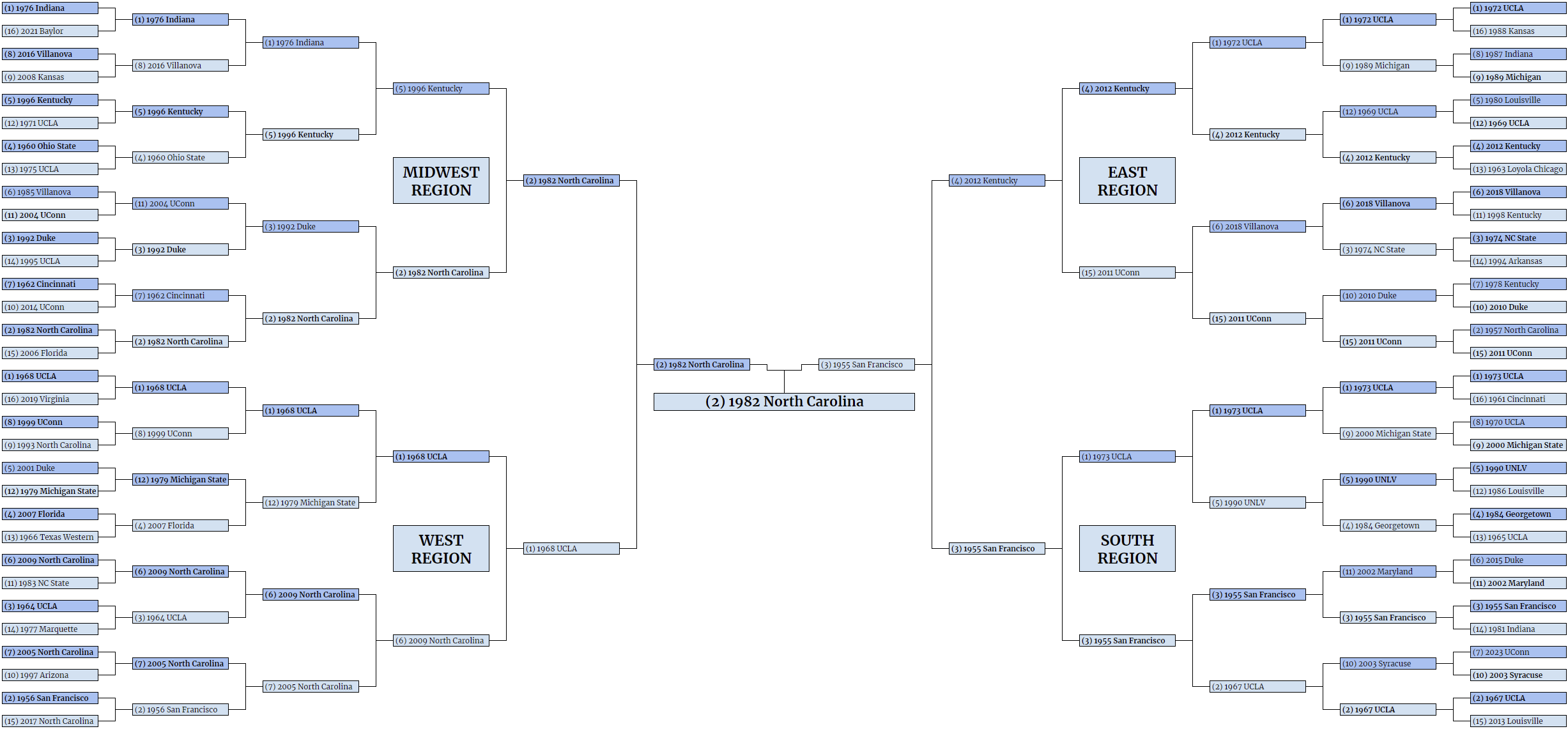
To access the final bracket for the Tournament of Champions, please click on the link provided.
Related Articles